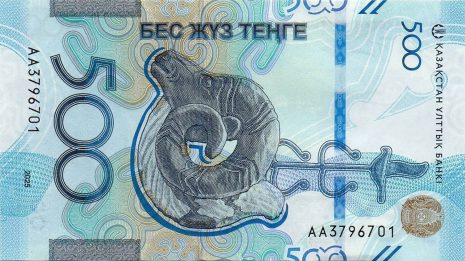
Kazakhstan

New holographic technology has designs on banknote security

Technology continues to push the boundaries for banknote security holograms. Here, Dr Glenn Wood of the International Hologram Manufacturers Association looks at some of the latest developments.

Today, holographic technology remains very much to the fore as part of an array of overt features which make it quick and easy for people to recognise whether or not a banknote is bonafide. But new substrate technology, particularly the introduction of transparent ‘windows’ is being incorporated on banknotes to provide new levels of anti-counterfeiting complexity.

The commemorative 1,000 Tenge note produced by Papierfabrik Louisenthal for Kazakhstan and launched earlier this year takes optical sophistication to a new level. Not only does it feature a hologram showing typical rainbow colours but a small microlenticular patch viewed by transmission. The system is called Varifeye® and combines the best features of paper and polymer.

Kazakh holo
The optically variable feature on the new 1000 Tenge note of Kazakhstan showing microlenticular feature in the window and demetallised hologram below.

Previously, a deckle-edge window was created in the paper substrate during the process of cylinder-mould web formation as the stock fibers collect against the deckle, leading to the characteristic feather look. Latterly, the window has been cut into the paper after laminating to a polymeric layer. Then a clear stripe of film is laminated over it running from top to bottom of the note. The clear stripe contains the microlenticular image of a camel interchanging with the letter ‘K’ when tilted.

This feature can be viewed by transmission through the window. There is also a demetallised holographic image of the Astana Baiterek monument above the text ‘Organisation for Security & Co-operation in Europe’, interchanging with the date 2010 which are viewed by reflection where it falls over the paper. (This technology was first used on the Bulgarian lev banknotes in 2005, becoming the world’s first paper notes with see through window).

For polymeric substrates, the Bank of Australia has developed its Non-diffractive Switching Image (NSI). This appears like a dynamic watermark in the clear window of a polymer-based note. Being non-diffractive, the images are seen in varying shades of grey rather than rainbow colours and switching of the image elements occurs by rotation rather than tilting.

Mexico has also embraced new technology – the country’s 100 peso note has an ingenious feature which outwardly looks holographic but is in fact transparent optically variable inks (they are usually opaque) printed on the clear window of a polymer note. The viewer can look at the feature either by transmission or reflection. The inks change colour in both modes but the colours seen by transmission are the complementary colours of those seen by reflection.

The latest innovation in holographic technology which makes use of traditional (though modified) embossing technology is the Asterium feature from Toppan printing in Japan. Viewed in normal direct light this feature appears black but when inclined at an extreme angle, the rainbow colours of an embossed hologram appear. The important feature here is the optical black which gives a new aesthetic to documents and only reveals the colourful security feature as and when required.

cancer_frontcancer_tilt
Asterium from Toppan uses optical black in conjunction with a hologram.

Another innovator, Kurz, has developed a revolutionary wafer thin security photopolymer which can record a volume holographic image for banknotes produced for Swiss National Bank. Kurz’s success has been to develop the material thin enough for use on a banknote, especially given that the reason this is called a ‘volume’ hologram is that the interference fringes are recorded within the depth of the photo-sensitive material. Similar developments are taking place in Japan where Dai Nippon Printing is leading the way.

OVD Kinegram, a division of Leonhard Kurz, continues to push the boundaries with its Kinegram reColor®. This has been developed for use as a laminate in conjunction with a window or aperture in the banknote substrate, and provides fundamentally different, and unexpected, effects depending on whether the note is viewed from the front or reverse. On the front the viewer sees a normal metallised reflective, diffractive image, while the reverse view shows a patterned coloured foil also displaying the diffractive features. The trick is performed using different coloured resist lacquers in the demetallization process. More remarkable still is Kinegram reView® which appears the same, metallic color on both sides of the image although the images seen on the two faces can be different and unrelated to each other.

ReView frontReView back
ReView from L. Kurz displays different holographic images when viewed from opposite side of a window.

One way or another, it seems that the window technology now becoming available to printers of banknotes is here to stay. Formerly, the opaque nature of security printing paper only allowed a watermark to be seen by transmission but most holograms are, by nature, transmissive and are rendered reflective by applying a metal coating. Once the opportunity is presented to allow them to be seen by transmission, as in a window, the opportunities for an optical tour de force are increased. This renders the note more visually attractive to inspectors and consumers and more difficult to simulate by counterfeiters.

However, here’s a cautionary word. Any trend towards simplification must be seen as a move in the right direction and run hand in hand with artists and graphic designers’ abilities to make good use of the media or of the public’s ability to appreciate and evaluate the security benefits offered by the latest technology. After all, it’s not as though holograms represent the only security feature on a banknote.

They are often one of many - for example, the 1000 Tenge note for Kazakhstan has at least 16 features including one to help the blind or partially sighted. So, it isn’t necessary to fill the hologram with every conceivable feature rather remember why the hologram was originally introduced: it provided a feature that could not be photocopied. Photopolymers provide this, so there’s no reason to suppose that holographic technology will not continue to be an integral security feature on future generations of banknotes.

END

The International Hologram Manufacturers Association (IHMA) is made up of 90 of the world's leading hologram companies. IHMA members are the leading producers and converters of holograms for banknote security, anti-counterfeiting, brand protection, packaging, graphics and other commercial applications around the world. IHMA member companies actively cooperate to maintain the highest professional, security and quality standards.

Issued on behalf of the IHMA by Mitchell Halton Watson Ltd. For further details contact Andy Bruce on +44 (0) 191 233 1300 or email andy@mhwpr.co.uk
|

Kazakhstan new 1,000-tenge commemorative confirmed

Kazakhstan_ 1000_2010.00.00_B35a_fKazakhstan_ 1000_2010.00.00_B35a_rkazakhstan_-1000_2010.00.00_b35a_sig

The National Bank of Kazakhstan issued a new 1,000-tenge note on 5 January 2010 to commemorate Kazakhstan’s chairmanship of the Organization for Security and Co-operation in Europe in 2010.

A total of 10 million notes will be issued at face value (US$6.75). The note dated 2010 is the same size (134 x 70 mm) as the current note of the same denomination, though the color is now turquoise-green, and the designs are as follows:


Obverse: State Emblem of the Republic of Kazakhstan in left upper corner, decorative image of flying birds in national style, face value in Kazakh language in the center, motives of Kazakh national patterns along the banknote, holographic image of Baiterek monument , color-changing logo of National Bank of Kazakhstan on the right part

Reverse: State Flag of the Republic in the left lower corner, Akorda palace of President of the Republic of Kazakhstan in the center with face value in Russian language, image of a bird and year of issue 2010, numerical indication of face value in the left lower part, motives of Kazakh national patterns along the banknote.

Courtesy of Vadim Tislenko.

|

Kazakhstan issues commemorative 5,000-tenge note

Kazakhstan_5000_2008.00.00_specimen_fKazakhstan_5000_2008.00.00_specimen_r
5,000 tenge (US$41.30), 2008. Introduced 2008 to commemorate 15 years of tenge. Red and brown on m/c underprint. Front: Astana-Baiterek monument; sheet music; national emblem; palm; flag; green-to-blue Spark flying eagle; jubilee inscription at edges. Back: Independence Monument and Kazakhstan hotel in Almaty; mountains. Watermark, windowed security thread, registration device, intaglio printing, OVI, microprinting, fluorescent serial numbers, iridescent ink, latent image of denomination, and pink fibers that fluoresce red under UV light. Printer: De La Rue (w/o imprint). 144 x 76 mm.

Also available as a specimen with all-zero serial numbers, red diagonal SPECIMEN overprint, numbered in the lower right-hand front corner.
|

Kazakhstan’s new note series misspells “bank”

page0_blog_entry198_1page0_blog_entry198_2page0_blog_entry198_3
Officials at the National Bank of Kazakhstan admit that there’s a problem with the new series of notes issued on November 15. The word “bank” on some of the new notes is misspelled with an alternate Kazakh form of the letter K (above, top), not the Cyrillic version (above, bottom), which has a slightly different pronunciation. Despite politicians’ calls to scrap the new issue, bank officials plan to release the error notes and then gradually withdraw them from circulation.

This error affects only some 2,000- and 5,000-tenge notes, and not the other denominations in this new series. Curiously, the misspelled “bank” appears on both sides of the KZT2,000 (US$15.65), but only on the face of the KZT5,000 (US$39.10).

Courtesy of Olexandr Danishenko and Eduard Han.
|

Kazakhstan issues new note series

Today the National Bank of Kazakhstan began issuing a new series of notes. This completely redesigned series share similar design elements on front (vertical format) and back (horizontal), distinguished primarily by different color schemes and printed denominations. The previous series (Pick 20 - 27) featuring a portrait of Al-Farabi will circulate in parallel with the new series for a period of one year.

The front of each note features the Astan-Baiterek monument in center, with a fragment of printed music of the national anthem overprinted with the numerical denomination. National emblem at left, along with an opened palm, and flag at right. The back of each note features a different main image within the outline of Kazakhstan’s boundaries.

The following security features appear on all notes: watermark, metallic windowed security thread, registration device, intaglio printing, OVI, microprinting, fluorescent serial numbers, iridescent ink, latent image of denomination, and pink fibers that fluoresce red under UV light.

page0_blog_entry174_1page0_blog_entry174_2
200 tenge, 2006. Orange and green. Front (vertical): Astana-Baiterek monument; sheet music; national emblem; palm; flag. Back: Transport and Communication Ministry building; winged statue on bridge over river Ishim in Astana; Ministry of Defense building; steppe. Solid security thread. Windowed security thread with demetalized 200 and text. Watermark: Snow leopard with electrotype 200 and deer. Printer: (BFoNBK). 126 x 64 mm.

page0_blog_entry174_3page0_blog_entry174_4
500 tenge, 2006. Blue and gray. Front (vertical): Astana-Baiterek monument; sheet music; national emblem; palm; flag. Back: Ministry of Finance building; Astana city hall; gulls over the sea. Solid security thread. Windowed security thread with demetalized 500 and text. Watermark: Snow leopard with electrotype 500 and animal lying down. Printer: (BFoNBK). 130 x 67 mm.

page0_blog_entry174_5page0_blog_entry174_6
1,000 tenge, 2006. Yellow and brown on m/c underprint. Front (vertical): Astana-Baiterek monument; sheet music; national emblem; palm; flag. Back: Presidential Culture Center building; mesas. Solid security thread. Windowed security thread with demetalized 1000 ТЕҢГЕ and ornament. Watermark: Snow leopard with electrotype 1000 and camel. Printer: (BFoNBK). 134 x 70 mm.

page0_blog_entry174_7page0_blog_entry174_8
2,000 tenge, 2006. Green and blue. Front (vertical): Astana-Baiterek monument; sheet music; national emblem; palm; flag. Back: Abai Opera-House building in Almaty; mountain lake. Solid security thread. Windowed security thread with demetalized 2000 and text along scrolling line. Watermark: Snow leopard with electrotype 2000. Printer: (TDLR and BFoNBK). 139 x 73 mm.


page0_blog_entry174_9page0_blog_entry174_10
5,000 tenge, 2006. Red and brown. Front (vertical): Astana-Baiterek monument; sheet music; national emblem; palm; flag. Back: Independence Monument and Kazakhstan hotel in Almaty; mountains. Solid security thread. Windowed security thread with demetalized 5000 ТЕҢГЕ and ornament. Watermark: Snow leopard with electrotype 5000. Printer: (TDLR and BFoNBK). 144 x 76 mm.

page0_blog_entry174_11page0_blog_entry174_12
10,000 tenge, 2006. Violet and blue. Front (vertical): Astana-Baiterek monument; sheet music; national emblem; palm; flag. Back: Akorda Palace (the presidential residence in Astana); canyons. Optiks security thread. Solid security thread. Watermark: Snow leopard with electrotype 10000 and elk. Printer: (TDLR and BFoNBK). 149 x 79 mm.

All notes have the same watermark of a leopard head, along with electrotype denomination and different animals (such as the camel shown here).

page0_blog_entry174_13

Courtesy of Olexandr Danishenko and Eduard Han.
|

Kazakhstan new varieties of Pick 13, 20, and 21 confirmed

page0_blog_entry154_1page0_blog_entry154_2page0_blog_entry154_3

There are two different 100-tenge notes dated 1993. The original (Pick 13a, top left) was issued in 1993. It features an intaglio rosette in the upper left corner of the front of the note. There is a second variety also dated 1993 (top right), but issued in 2001. It has the rosette in OVI.

There are two different 200-tenge notes dated 1999. The original (Pick 20, middle left) was issued in 2000. It features the denomination embossed on a rosette in the lower right corner of the front of the note. There is a second variety (middle right) also dated 1999, but issued in 2002. It has a latent image instead of embossing, and a different background design to the right of the portrait.

There are two different 500-tenge notes dated 1999. The original (Pick 21, bottom left) was issued in 2000. It features the denomination embossed on a rosette in the lower right corner of the front of the note. There is a second variety (bottom right) also dated 1999, but issued in 2002. It has a latent image instead of embossing, and a different background design to the right of the portrait. This note is listed as Pick 27, erroneously indicated as a 2004 issue.

If anyone has additional information about these or other unlisted varieties for other denominations, please add your comment below.

Courtesy of Eduard Han.
|